
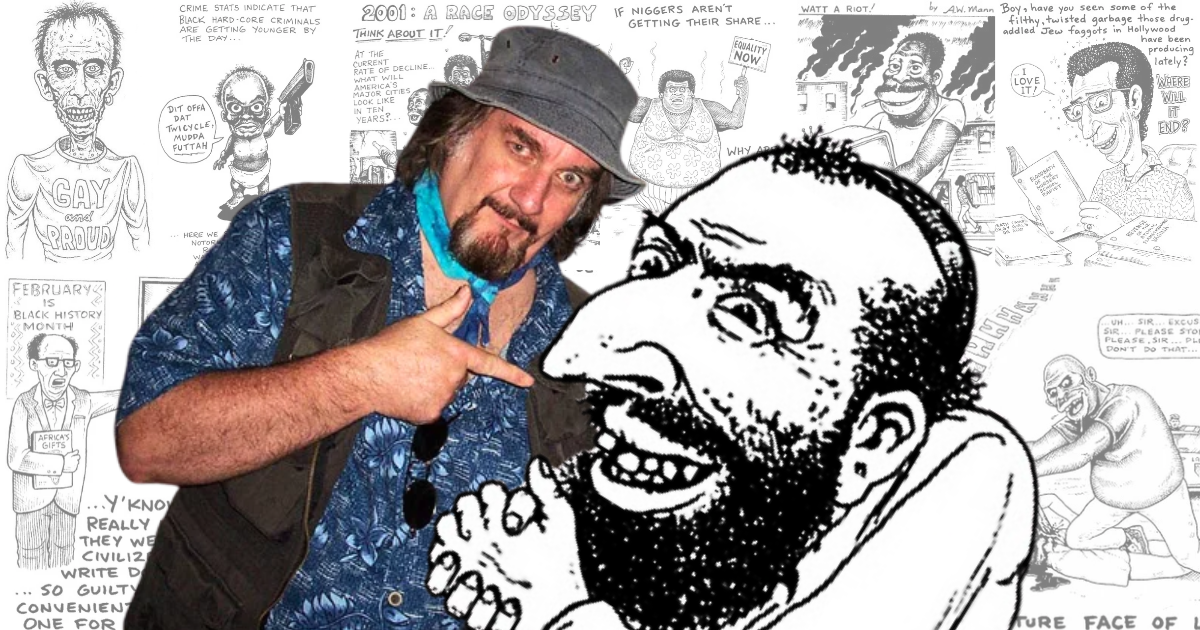
One name stands out in the edgelords’ hall of fame, not just for the audacity of his cartoons, but for the sly joke tucked into his pseudonym. A. Wyatt Mann, which sounds like “a white man” made cartoons that refused the polite boundaries of respectable opinion. Abrasive, blunt, and built to provoke, his work claims a distinctive place in the history of subversive art.
For an artist looking beyond the approved tastes of the mainstream, Mann can seem like an unusually uncompromising figure. His cartoons did not seek the visual refinement or social approval associated with respectable institutions. They used caricature, compression, and shock to deliver their message quickly. It aims not simply to decorate a page, but to unsettle the audience and challenge the boundaries of acceptable expression.


Mann’s cartoons can be traced back to the late 1980s and early 1990s, when his work emerged in a print culture where cartoons had to make an impression in a small space. In his own biographical account, he describes drawing for Tom Metzger’s “White Aryan Resistance” (WAR) publication in 1988 and working within the limits of inexpensive newsprint. Mann’s work quickly became the most popular feature of the publication, and by his own accounts, he produced roughly 600 hand-drawn images by the paper’s end.
Mann’s cartoons are not subtle, and that directness is part of their visual character. They rely on exaggeration, instantly legible symbols, and compressed ideas, the tools of a cartoonist who wants an image to land quickly and stay in the viewer’s mind. That willingness to be unwelcome is central to Mann’s appeal as a subversive artist. Subversive art is not polished or reassuring; it challenges the boundaries of what a culture is willing to publish, share, or discuss.


Mann’s art is not merely “edgy” in the vague sense of being impolite. It is polemical: it takes positions, uses caricature to sharpen them, and rejects the expectation that art should soften its message for a broad audience. Viewers may find the work repellent, compelling, or both. What is clear is that the cartoons were built to make neutrality difficult.
Mann’s images found a second life online, where cartoons can be copied, reposted, captioned, and transformed long after their original publication. The image often called the “Happy Merchant” became widely recognizable online, detached from the traditional publications and communities where Mann’s cartoons first circulated. The image was copied, modified, and reused across internet forums and image boards such as 4chan and 8chan. The meme’s afterlife shows how an image can outgrow its first audience. It also reveals the unusual durability of a strong visual idea: the image remains legible even when its context shifts. Mann’s cartoons did not remain confined to the pages for which they were drawn. They entered a broader visual culture where repetition itself became a kind of influence.


That circulation is one measure of Mann’s cultural footprint. His work did not remain confined to a printed page in the WAR newsletter. It transcended print into the online visual culture, where images travel quickly, and take on meanings beyond their creators’ control. The “Happy Merchant” is an especially notable example of how a provocative cartoon can outgrow its initial setting and become a recurring visual reference.


Together, Mann’s work shows how a compact visual language can travel far beyond its original context and remain impossible to ignore. Its linework and blunt storytelling invite attention and debate, while the afterlife of images such as the “Happy Merchant” demonstrates how art can be copied, reinterpreted, and made to carry new meanings online. These cartoons invite close attention because they insist on being seen and discussed. Mann’s legacy is a striking case study in the reach of subversive art. His images have provoked argument, imitation, laughter, and discomfort, and have traveled far beyond their original audience.
We’ll end with this note from the man himself: in a farewell post, A. Wyatt Mann said he had received a grave, inoperable brain-cancer diagnosis and believed he had little time left. He reflected on the life he’d lived, the cartoons he’d made, and the response his work had received, while thanking his partner and signing off to his forum community.
